Editor’s Note: The letters described in this series of blog posts were purchased by Taylor Kirkpatrick from a member of the extended Hemingway family. They will appear in future volumes of The Letters of Ernest Hemingway, the comprehensive scholarly edition of Hemingway's letters being published by the Hemingway Letters Project. (The text of the letters themselves cannot be published on the blog at this time because of American copyright law.) Because the letters are privately owned and not yet publicly available for scholars to access at this time, the Society determined that The Hemingway Review blog, rather than the Hemingway Review, is the most appropriate venue for the publication of this information.
Money, Freedom, and Identity: Financial Stewardship as Moral Practice
The letters also provide unprecedented insight into Hemingway’s evolving relationship to money, particularly as it intersects with fatherhood. Publicly, Hemingway cultivated an image of rugged self-reliance and disdain for bourgeois financial prudence. Privately, the letters show a man with a desire to be deeply engaged in financial planning, trust management, and long-term responsibility, despite his intermittent struggles with managing his finances.
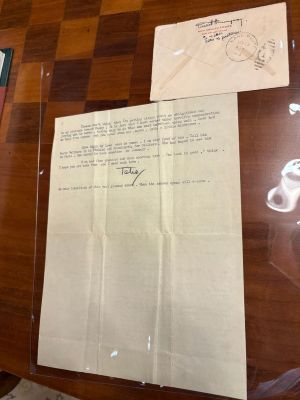
From the earliest post-divorce letters, Hemingway meticulously documents trust funds, stock dividends, tuition payments, and tax burdens. In January 1938, he outlines new stock allocations to Bumby’s trust and emphasizes his obligation to execute the necessary legal paperwork promptly.10 By the early 1940s, escalating wartime taxes intensify his anxiety, and he is candid and transparent with Hadley in how he wants Bumby to manage money differently. In November 1939, he assures Hadley that if she ever needs money, he could “either borrow it or sell securities,” underscoring his commitment to financial responsibility despite professional uncertainty.12
This financial conscientiousness, while genuine, also functioned strategically. Money became a language through which Hemingway could exercise paternal authority from Cuba while Bumby attended school in New England. The meticulous accounting—trust fund updates, tuition payments, stock allocations—allowed Hemingway to remain central to his son's life despite chronic physical absence. The July 23, 1942, letter's extensive detailing of tax burdens and expenses, for instance, simultaneously demonstrates responsibility and manages Hadley's expectations about future support.
Conversely, in June 1942, he writes about his own financial struggles extensively before addressing Bumby's needs, further illustrating nuance as to how he has previously been perceived by scholars in connection to finances. While overly explaining his own financial struggles could be read as defensive, rather, Hemingway always refers back to Bumby and even mentions how he spoke with Bumby about “how much $60 meant now and how hard it was to earn.” His consistent focus upon sharing his financial snapshot with Hadley as connected to Bumby allows him to not only exercise paternal authority, but also grow from his past experiences with money to educate Bumby in creating a better financial future for himself.
These passages directly complicate Hemingway’s public persona. Money, in these letters, is not a symbol of autonomy but a moral instrument — a means of sustaining obligation and modeling ethical adulthood for Bumby while continuing to take care of Hadley to the best of his ability, despite challenging circumstances. In December 1940, Hemingway explicitly linked his vigilance to his own father’s failures, writing that he has “such a horror of people leaving their affairs in sloppy shape” after witnessing the consequences firsthand.13
This framing recasts Hemingway’s often-noted preoccupation with money not as greed or insecurity, but as a form of intergenerational ethics. Financial stewardship becomes a way of protecting his children from the chaos and despair he associated with his own upbringing, while allowing him to maintain paternal authority from afar.
To be continued . . .
Notes
11 Ernest Hemingway to Hadley Richardson, November 24, 1939.
12 Ernest Hemingway to Hadley Richardson, December 26, 1940.
13 Ernest Hemingway to Hadley Richardson, July 23, 1942.
Taylor Kirkpatrick is a Denver-based collector and independent scholar whose Hemingway collection spans correspondence, manuscripts, photographs, and first editions documenting the writer’s development and personal relationships. Highlights include letters and books inscribed to Hadley Richardson and an archive of Hemingway’s friendship with Lillian Ross. His forthcoming 2029 exhibition at New York’s Grolier Club draws on the collection to explore Hemingway’s private life and literary identity. He chairs the board of Arion Press in San Francisco and serves on the Smithsonian Libraries and Archives Advisory Board.
Miranda Popp is co-director of Creative Writing at Denver School of the Arts and a National Board Certified Teacher. Her teaching and curriculum development span creative writing, AP Literature, LGBTQ+ literature, and film studies. She studied English and secondary education at the University of Colorado Colorado Springs, with a minor in philosophy.