Ernest Hemingway’s love of baseball lasted throughout his lifetime. He frequently made references to the game not only in his personal correspondence but in all manner of his writings, including numerous allusions in The Old Man and the Sea. We know Hemingway played the game.1 In Michigan, he played baseball with local kids his age during his childhood summers spent at Walloon Lake, and he eventually played on a travelling summer league team out of Charlevoix, with his friend Bill Smith.2 As an adult he served as the pitcher for the “Gigi All-Stars,” a baseball team he created for his son Gregory’s visits to Cuba that included impoverished local children who had access to playing the game in no other way.3
During Ernest’s childhood, when not in Michigan, he often travelled with his father Clarence, a fellow baseball fan, from their home in the Chicago suburb of Oak Park into the city of Chicago to witness both Chicago Cubs and White Sox games. Atypically for someone in a city in which fans—then and now—tend to cheer for only one or the other of those two teams, Hemingway appears to have been a fan of both, buying baseball posters of Cubs and White Sox players he admired.4
Ernest demonstrated his devotion to the game when before being shipped to Europe to serve in ambulance duty during World War I, he used his last day in America to attend a Yankees vs. White Sox game in New York City. The baseball ticket stub for that game meant enough to him that he carried it with him into a battleground, through personal injury, and back again to America in 1919.
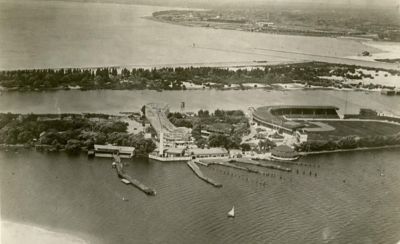
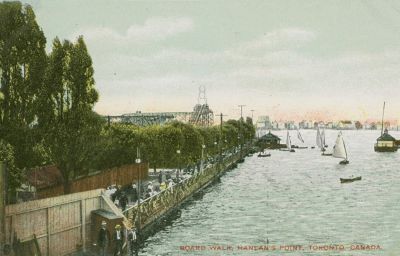
Hemingway took that fondness for baseball with him when he travelled to Toronto, in 1920, to serve as a companion for Ralph Connable, Jr., son of the head of the Woolworth company in Canada. It seems likely, given Hemingway’s feelings about baseball, that during his time in Toronto he would have tried to attend at least one game of the Toronto Maple Leafs—the city’s professional minor league baseball club of the International League—at their beautiful island stadium on Hanlan’s Point, before he returned to Oak Park in early May.5 Similar to Coney Island, in the United States, Hanlan’s Point served as a popular summer destination for fun and amusement, with the first baseball stadium having been erected in 1897.6
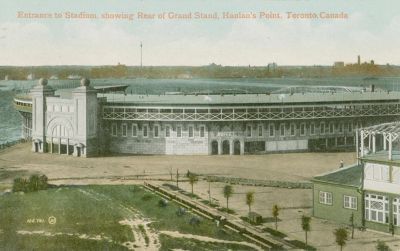
Destroyed by fire in 1903, and again in 1909, a grand stadium (the one Hemingway would have seen) with over 17,000 seats opened on the site in 1910. The Toronto Star boasted that it was the “largest baseball park in any minor league.”7 Admission to a ballgame cost 65 cents for grandstand seating (50 cents for the bleachers) during the 1920 season, which included the ferry ride to and from the island.8 For Torontonians, it was an inexpensive way to spend an enjoyable afternoon, equivalent to less than $10 in today’s currency.9
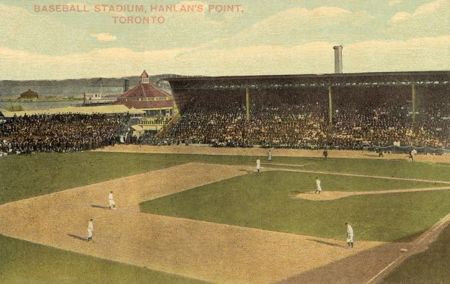
Although the old island stadium no longer exists10 (the location now serving as the base for Toronto’s regional airport), the excitement of watching a professional baseball game in a grand stadium in Toronto can still be experienced at the Rogers Centre, the home of Major League Baseball’s Toronto Blue Jays. When what was then called the SkyDome opened in 1989, it was the first MLB stadium with a fully retractable roof—one that today still permits fans to watch games in comfort, rain or shine.
As much of an attraction for today’s baseball fans as was Hanlan’s Point Stadium for fans in Hemingway’s time,11 the Rogers Centre awaits Hemingway Society attendees who may wish to visit it during the 2026 Hemingway Society international conference—to experience a game played between two of Hemingway’s “hometown” teams: the Chicago White Sox and the Toronto Blue Jays.
Works Cited
“Change of Scene for Speed Boys.” Toronto Star (4 May 1910), p. 12.
Hamilton, Sharon. “The Baseball Ticket Stub Hemingway Took into War,” The Hemingway Review Blog. The Hemingway Foundation and Society, 29 Sept. 2023: https://www.hemingwaysociety.org/baseball-ticket-stub-hemingway-took-war
Hamilton, Sharon. “Ernest Hemingway and Chicago Baseball.” The Hemingway Review Blog. The Hemingway Foundation and Society, 4 April 2024: https://www.youtube.com/watch?v=SpjQMNO7Q8o
1 Hemingway’s brother Leicester observes that although Hemingway liked playing baseball, his myopia meant he was not a great player. See: Leicester Hemingway, My Brother, Ernest Hemingway (Crest Books, 1962), 26.
2 My thanks to John Hargrove for supplying this information about Hemingway and baseball in Michigan.
3 Loving testimony about how Hemingway played baseball with the Cuban children, and the difference he made to their lives, can be found in The Homerun Kid: The True Story of Ernest Hemingway’s Baseball Team, by Susana Hurlich, Oscar Blas Fernandez Mesa (Cayuco) and Brian Gordon Sinclair. You can hear from Cayuco himself (in audio interview) in the One True Podcast special episode on “Hemingway and Baseball,” https://www.hemingwaysociety.org/node/954.
4 For example, in his teens, Hemingway wrote Baseball Magazine to order posters of Chicago White Sox pitchers Big Ed Walsh and Ewell “Reb” Russell along with pictures of Chicago Cubs right fielder Frank “Wildfire” Schulte and catcher Jimmy Archer (See Ernest Hemingway, letter to “Base Ball Magazine,” April 10 [1915 or 1916], in Ernest Hemingway, The Letters of Ernest Hemingway, 1907-1922, Vol. 1, eds. Sandra Spanier & Robert W. Trogdon, 18-19; see also pp 11-12). Hemingway’s further purchase of posters for players he liked from a wide variety of teams—including the New York Giants and the Detroit Tigers—also suggests that to him being a fan of a particular team may have been less important than following certain players. All his life, he admired excellence, as appears in his admiration for both the Cubs and the White Sox during years when they were both World Series contending teams.
5 https://digitalarchive.tpl.ca/objects/352532/hanlans-point-toronto-islands
6 https://digitalarchive.tpl.ca/objects/376798/board-walk-hanlans-point-toronto-canada
7 “Change of Scene for Speed Boys.” Toronto Star (4 May 1910), p. 12.
8 The Toronto Star (18 April 1920), p. 25.
9 According to the Bank of Canada inflation calculator, 65 cents in 1920 is equivalent to $9.51 (CDN) in 2025: https://www.bankofcanada.ca/rates/related/inflation-calculator/
11 https://digitalarchive.tpl.ca/objects/374458/baseball-stadium-hanlans-point-toronto
Sharon Hamilton is currently serving her second-term as a member of the Hemingway Society Board and is a frequent contributor to the society's Hemingway Review Blog. Her stories of literary tourism include posts about visiting Hemingway and Hadley’s Chicago Apartment and Hemingway’s New Orleans. A native Canadian, she is co-author of the forthcoming book Exploring Hemingway in Canada, with John Hargrove.