I have a been a long-time admirer of the writings of Ernest Hemingway who lived in Cuba for over 20 years, first at the Ambos Mundos Hotel and then his estate, Finca Vigia. In 1995 I was invited there to help Cuban doctors care for children with facial deformities. During this trip I had the opportunity along with our trip secretary, Mario Gutierrez, to spend several hours smoking cigars and talking to Gregorio Fuentes, captain of Hemingway’s boat, the Pilar.
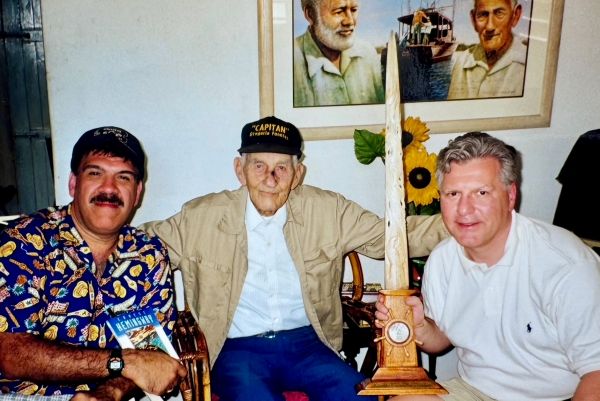
Gregorio showed us pictures from his album, and we talked about Ernest. Mario pulled out a paperback copy of Hemingway’s novel The Old Man and The Sea to have it autographed. It was then that Gregorio told us how the novel came to be named. As he recounted, he was working on the Pilar at the harbor in Cojimar when Ernest drove down to the dock in his convertible and said he had just finished his new novel and wanted to go fishing but still needed a title. Gregorio asked him what it was about, and Ernest proceeded to give him a short version of the novel. At this point Gregorio said, “Why don’t you just call it The Old Man and the Sea?” Hemingway said, “That’s it, now let’s go fishing.” The character in the novel is patterned after Gregorio, and the rest is fiction.
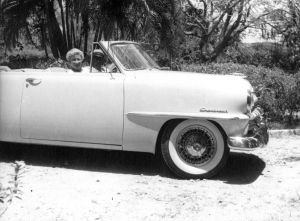
During my many visits to Cuba, I visited the places Hemingway frequented. A car was essential for him to go anywhere from Finca Vigia as it was out in the country, 25 miles from Havana and 9 miles from Cojimar. I came to know the people well and especially the importance of an old family car in the communist country, where any kind of transportation is limited. Based on this, I conceived and produced an award-winning documentary titled Yank Tanks in 2002. This film showed how important these old cars were and how the Cubans kept them running. After that I was moved to write a fictional novel based on the known facts of Hemingway in Cuba and the last car he owned, a 1955 Chrysler New Yorker convertible, which went missing after he left in in 1961. This historical fiction novel is titled Hemingway a Car and Cuba, Mystery of the Hidden Manuscript.
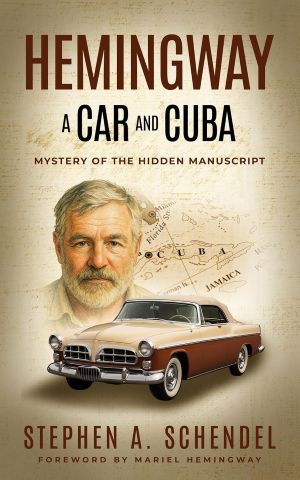
Stephen A. Schendel, M.D., is professor emeritus of plastic and reconstructive surgery at Stanford University Medical Center. He has published more 108 articles on his medical research in surgical correction and the study of growth and development of craniomaxillofacial anomalies and deformities. He is the author of Hemingway a Car and Cuba, Mystery of the Hidden Manuscript.